Contents
- 1 What Are the Chances of a Child Inheriting Bipolar From One Parent?
- 2 Understanding Bipolar Disorder Inheritance and Genetic Risk in Children
- 3 Understanding Bipolar Disorder and Genetics
- 4 Risk Percentages When One Parent Has Bipolar Disorder
- 5 Why the Risk Range Is Wide
- 6 What Recent Studies Show
- 7 Why Genetics Increase Risk but Do Not Decide Fate
- 8 One Parent Versus Two Parents With Bipolar Disorder
- 9 Factors That Can Increase a Child’s Risk
- 10 Protective Factors That Reduce Risk Impact
- 11 Early Signs to Watch For in Children and Teens
- 12 Step by Step: What Parents Can Do
- 13 Common Myths and Facts
- 14 Conclusion and Final Thoughts
- 15 Frequently Asked Questions About Bipolar Disorder Inheritance
What Are the Chances of a Child Inheriting Bipolar From One Parent?
Understanding Genetic Risk, Family History, and Bipolar Disorder Inheritance
Understanding Bipolar Disorder Inheritance and Genetic Risk in Children
What are the chances of a child inheriting bipolar disorder from one parent? Learn the genetic risk, contributing factors, and what research shows about inheritance.
For many parents living with bipolar disorder, the question of inheritance is deeply personal. It is not just a medical concern.
It is emotional. It often comes with fear, guilt, and a desire to protect a child from struggle. Parents may wonder if their diagnosis means their child is destined to face the same challenges.
The truth is more balanced and far more hopeful than many people expect. Bipolar disorder does have a genetic component, but genetics alone do not determine outcomes.
Having one parent with bipolar disorder increases risk, but it does not guarantee that a child will develop bipolar disorder.
In fact, most children of parents with bipolar disorder do not develop the condition.
This article explains the science in clear language. It breaks down real percentages, recent research, and what those numbers actually mean in everyday life.
It also explains what raises risk, what protects against risk, and how parents can support their child in practical, grounded ways.
The goal is clarity, not fear. Knowledge helps families focus on prevention, stability, and emotional health.
What are the chances of a child inheriting bipolar disorder from one parent?
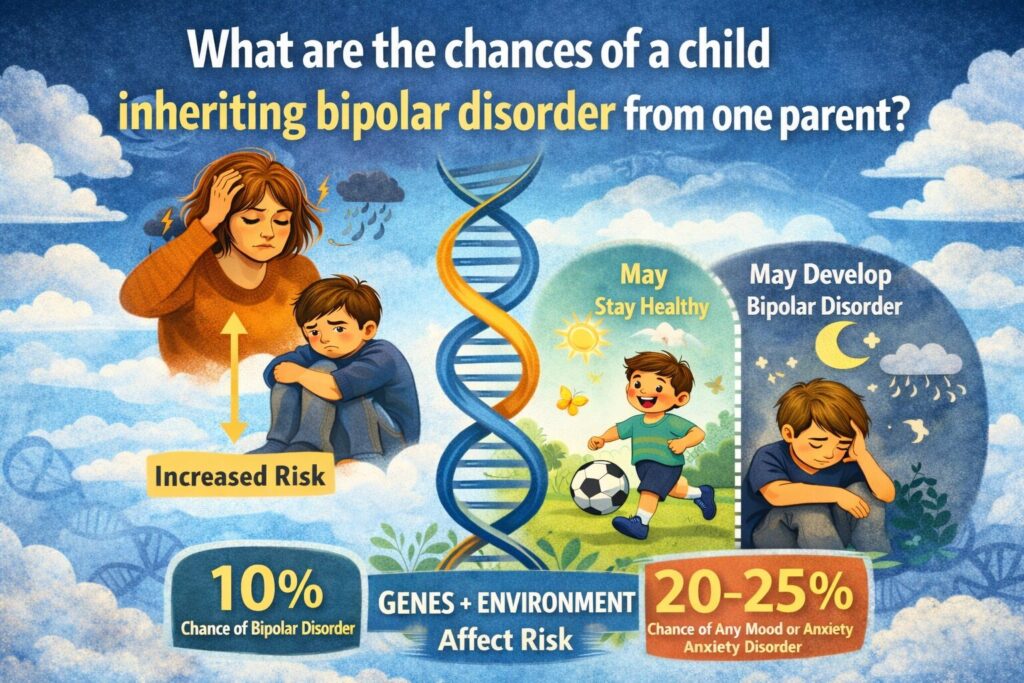
When one parent has bipolar disorder, research suggests the child has an estimated 4 percent to 15 percent lifetime risk of developing bipolar disorder. This is higher than the general population, but most children do not develop bipolar disorder. Genetics increase vulnerability, not certainty.
Understanding Bipolar Disorder and Genetics
Bipolar disorder is a mood disorder characterized by shifts between depressive episodes and manic or hypomanic episodes.
These mood changes affect sleep, energy, thinking, emotions, and behavior.
Bipolar disorder exists on a spectrum, which includes Bipolar I, Bipolar II, and related mood conditions.
Symptoms and severity can vary widely from person to person.
Genetics play a significant role in bipolar disorder.
Family studies consistently show that bipolar disorder appears more often among close relatives than in the general population.
However, bipolar disorder is not caused by a single gene. Instead, it involves many genes, each contributing a small amount of risk.
These genetic factors interact with life experiences, stress levels, sleep patterns, and environment.
This is why inheritance does not work like passing on eye color.
A child may inherit a vulnerability to mood instability, but whether that vulnerability develops into bipolar disorder depends on many factors over time.
Genetics set the stage, but environment and lifestyle influence how the story unfolds.
Can Bipolar Disorder Be Inherited? Understanding Genetic Risk From One Parent
This video explains how bipolar disorder can run in families and what that means for children when one parent has bipolar disorder.
Risk Percentages When One Parent Has Bipolar Disorder
Estimated Risk at a Glance
When researchers follow families over many years, they observe patterns that help estimate risk. These estimates are averages across large groups of people. They are not predictions for any individual child.
When one parent has bipolar disorder, research commonly reports:
- About 4 percent to 15 percent lifetime risk of bipolar disorder in the child
- A higher risk of mood disorders overall, including depression and anxiety
- Increased likelihood of symptoms emerging during late adolescence or early adulthood
In comparison, the estimated risk of bipolar disorder in the general population is often cited as around 1 percent to 2 percent.
Why These Numbers Matter
These numbers help put risk into perspective. While the risk is higher than average, it also means that 85 percent to 96 percent of children of parents with bipolar disorder do not develop bipolar disorder. This context is important for reducing fear and focusing on realistic prevention strategies.
Why the Risk Range Is Wide
Differences in Study Design
Risk estimates vary because studies measure different outcomes. Some studies count only Bipolar I disorder. Others include Bipolar II or cyclothymia. Some track only hospital diagnoses, while others include outpatient care.
Age of Follow Up
Many mood disorders emerge later in life. Studies that stop following children in early adolescence may miss cases that appear in late teens or adulthood. Longer studies tend to report higher lifetime risk because they capture more years of vulnerability.
Diagnostic Complexity
Bipolar disorder is often diagnosed after years of symptoms. Many people experience depression first. Others show anxiety or attention related symptoms early on. This delay can affect how risk is counted in research.
What Recent Studies Show
Long term studies provide the most reliable insight into inheritance patterns.
One well known long follow up study tracked children of parents with bipolar disorder for more than twenty years.
Researchers found that the highest risk period for developing bipolar disorder occurred during late adolescence.
In that group, roughly 11 percent to 13 percent of high risk offspring developed bipolar disorder by early adulthood.
More recent research also highlights an important point.
Children of parents with bipolar disorder are at increased risk not only for bipolar disorder, but for a range of mental health conditions.
Depression, anxiety disorders, and emotional regulation difficulties appear more often in high risk offspring compared to the general population.
This does not mean these children are destined to struggle. It means early support, monitoring, and healthy routines can make a meaningful difference.
Why Genetics Increase Risk but Do Not Decide Fate
Heritability Explained in Simple Terms
Heritability refers to how much of the variation in a condition across a population is influenced by genetics.
Bipolar disorder has high heritability, meaning genetics play a strong role at the population level.
This does not mean a child inherits bipolar disorder directly from a parent.
A helpful way to think about this is vulnerability. Genetics may increase sensitivity to mood instability, but they do not determine outcomes on their own.
Polygenic Risk and Life Experience
Bipolar disorder involves many genes interacting with life experiences. Stress, trauma, sleep disruption, and substance use can increase risk.
Protective factors can reduce risk even when genetic vulnerability exists.
This interaction explains why siblings raised in the same household can have very different mental health outcomes.
One Parent Versus Two Parents With Bipolar Disorder
When one parent has bipolar disorder, the child’s risk increases modestly compared to the general population.
When both parents have bipolar disorder or there is a strong family history across generations, risk increases further.
Even in families with multiple affected relatives, bipolar disorder is not guaranteed.
Many children grow up without developing the condition, especially when protective factors are present and mental health is openly supported.
Factors That Can Increase a Child’s Risk
Family History Patterns
Certain family patterns may suggest stronger genetic loading.
- Bipolar disorder with early onset
- Severe manic episodes
- Psychotic features
- Multiple close relatives with mood disorders
- Recurrent hospitalizations
These patterns indicate increased vulnerability, not inevitability.
Environmental and Lifestyle Factors
Environment plays a powerful role in shaping outcomes.
- Chronic family conflict
- Unpredictable routines
- Ongoing sleep disruption
- High academic or social pressure
- Lack of emotional safety
Children thrive in stable environments. Predictability helps regulate developing nervous systems.
Protective Factors That Reduce Risk Impact
Protective factors can buffer genetic vulnerability and promote resilience.
- Consistent sleep and daily routines
- Emotional validation and support
- Open conversations about mental health
- Early coping and emotional regulation skills
- Access to mental health care when needed
Parents who manage their own bipolar disorder effectively also create a more stable environment. Treatment adherence, relapse prevention, and self awareness benefit the entire family.
Early Signs to Watch For in Children and Teens
Watching for signs does not mean constant worry. It means noticing patterns over time.
Possible Early Warning Signs
- Persistent sleep changes without fatigue
- Periods of unusually high energy paired with impulsive behavior
- Intense irritability lasting weeks rather than days
- Recurrent depression beginning early in life
- Risk taking behavior that feels out of character
These signs do not confirm bipolar disorder. They signal that professional guidance may be helpful.
Conditions That Can Look Similar
Many conditions share overlapping symptoms.
- ADHD
- Anxiety disorders
- Trauma related responses
- Typical adolescent emotional changes
This overlap is why diagnosis should always be made by trained professionals over time.
Step by Step: What Parents Can Do
Step 1: Observe Patterns Without Panic
Tracking patterns helps clinicians understand what is happening over time. Focus on sleep, mood, energy, stressors, and major changes. Patterns matter more than isolated behaviors.
Step 2: Protect Sleep as a Priority
Sleep stability is one of the strongest protective factors for mood regulation.
- Keep consistent bedtimes and wake times
- Limit late night screen exposure
- Create calming evening routines
Good sleep supports emotional regulation and brain health.
Step 3: Reduce Chronic Stress
Lowering ongoing stress supports mental health.
- Create predictable daily routines
- Address family conflict early
- Encourage balance between school, rest, and play
Stress management benefits both children and parents.
Step 4: Seek Professional Support Early
Early support does not mean labeling or medication. It means guidance, skills, and monitoring.
- Pediatricians can screen and refer
- Therapists can teach coping skills
- Psychiatrists can assess when symptoms are complex
Early care often prevents escalation.
Step 5: Talk Openly and Age Appropriately
Open conversations reduce shame and fear.
Simple language works best.
“Mood conditions can run in families. We focus on healthy habits and support.”
How likely is bipolar to be passed down?
Bipolar disorder is more likely to be passed down when a close family member has the condition, but it is not guaranteed. When one parent has bipolar disorder, research suggests the child’s lifetime risk is higher than average, often estimated between four percent and fifteen percent. Genetics increase vulnerability, but factors like sleep, stress, environment, and early support play a major role in whether bipolar disorder develops.
Common Myths and Facts
Myth: If I have bipolar disorder, my child will too.
Fact: Most children of parents with bipolar disorder do not develop bipolar disorder.
Myth: Bipolar disorder is only genetic.
Fact: Genetics matter, but sleep, stress, trauma, and environment also play major roles.
Conclusion and Final Thoughts
Living with bipolar disorder as a parent does not define your child’s future. Genetics influence risk, but they do not decide destiny.
When one parent has bipolar disorder, research suggests the child’s lifetime risk of developing bipolar disorder is higher than average, often estimated between 4 percent and 15 percent.
That also means the majority of children do not develop bipolar disorder.
Understanding risk allows families to focus on what truly matters. Stability, sleep, emotional safety, and early support make a real difference.
Open conversations reduce fear. Professional guidance provides clarity.
If you are a parent living with bipolar disorder, your awareness already matters.
Your care, your treatment, and your commitment to emotional health create a foundation that supports your child’s well being.
Genetics may open a door, but environment, support, and compassion help decide what happens next.
Frequently Asked Questions About Bipolar Disorder Inheritance
What are the chances of a child inheriting bipolar disorder from one parent?
When one parent has bipolar disorder, research suggests the child has an estimated four percent to fifteen percent lifetime risk of developing bipolar disorder. This risk is higher than the general population, but most children do not develop bipolar disorder. Genetics increase vulnerability, not certainty, and lifestyle factors like sleep, stress, and early support can influence outcomes.
Can bipolar disorder skip a generation?
Yes, bipolar disorder can skip a generation. A child may not develop bipolar disorder even if a parent has it because inheritance involves many genes and environmental factors. Protective factors such as stable routines, emotional support, and early mental health care can reduce the impact of genetic risk.
Is bipolar disorder inherited from the mother or the father?
Bipolar disorder can be inherited from either parent. Risk does not depend on whether the mother or father has bipolar disorder. Both parents contribute genetic material, and bipolar disorder inheritance reflects a combination of genes from both sides of the family.
At what age do symptoms of bipolar disorder usually appear in children with a family history?
Symptoms often emerge in late adolescence or early adulthood, but this varies widely. Some children may show early signs such as sleep disruption, recurring depression, or mood instability, while others may never develop symptoms. A qualified clinician can assess patterns over time.
Are children of parents with bipolar disorder more likely to develop depression or anxiety?
Yes, many studies show that children of parents with bipolar disorder have an increased risk of developing other mood or anxiety disorders, not just bipolar disorder. Depression or anxiety may appear first, which is why early monitoring and support are important.
What are early warning signs parents should watch for?
Parents should watch for persistent changes rather than isolated behaviors. Warning signs may include ongoing sleep changes without fatigue, intense mood swings that last weeks, increased impulsivity, recurring depression, or behavior that feels out of character. These signs do not confirm bipolar disorder but signal the need for professional guidance.
Reviewed by Doctor
Reviewed by: Dr. Maya Reynolds, MD
Specialty: Psychiatry, Mood Disorders, Child and Adolescent Mental Health
Credentials: Board Certified Psychiatrist
This article was reviewed for medical accuracy, clarity, and alignment with general clinical guidance on bipolar disorder risk and family history.
Medical disclaimer
This content is for educational purposes only. It is not medical advice and does not replace evaluation, diagnosis, or treatment from a qualified healthcare professional.
Trusted Medical and Research Sources on Bipolar Disorder Inheritance
- Depression and Bipolar Support Alliance (DBSA):
Provides information on the chances of passing bipolar disorder to children and explains genetic and environmental risk factors.
https://www.dbsalliance.org/education/ask-the-doc/what-are-my-chances-of-passing-mental-illness-on-to-my-children-and-could-it-potentially-get-worse/ - MedlinePlus (U.S. National Library of Medicine):
Offers an overview of bipolar disorder, its symptoms, and inheritance patterns, including how family history affects risk.
https://medlineplus.gov/genetics/condition/bipolar-disorder/ - WebMD – Bipolar Disorder Risk Factors:
Summarizes research on how family history influences the likelihood of bipolar disorder, including the increased risk when one parent has the condition.
https://www.webmd.com/bipolar-disorder/guide/bipolar-disorder-whos-at-risk
-
 Fostering Well-being: A Comprehensive Guide to Understanding Mental Health in the Workplace
 -
Black Women's Mental Health Support Groups
-
LGBTQ Friendly Therapists Near Me
-
Coping Strategies for Managing Hallucinations and Distorted Thoughts in Daily Life
-
Anxiety vs Stress: How to Tell the Difference in Real Life Video