A simple, non-clinical guide to building healthier screen habits, reducing digital overload, and creating a calmer daily routine.

By Kevin Mack, Mental Wellness Writer and Digital Content Strategist
Credentials | Founder of The Mental Health Blogger, 16+ years of online writing and content publishing experience: Updated: July 3, 2026
Contents
- 1 How to Create a Daily Mental Health Checklist for Digital Detoxing
- 2 Key Takeaways
- 3 Introduction
- 4 What Is a Daily Mental Health Checklist for Digital Detoxing?
- 5 Why Does a Daily Mental Health Checklist Matter for Digital Wellness?
- 6 Related Video
- 7 What Are the Main Signs You May Need a Digital Detox Checklist?
- 8 What Causes Unhealthy Screen Habits?
- 9 How Do I Create a Daily Mental Health Checklist for Digital Detoxing?
- 10 Sample Daily Mental Health Checklist for Digital Detoxing
- 11 Common Mistakes and Myths About Digital Detoxing
- 12 Expert Insights About a Daily Mental Health Checklist
- 13 Best Practices for Digital Detoxing Without Feeling Overwhelmed
- 14 People Also Ask:
- 15 Conclusion
- 16 Non-Clinical Disclaimer
- 17 About the Author
- 18 Sources and References
- 19 Related Articles from MentalHealthBlogger.com
How to Create a Daily Mental Health Checklist for Digital Detoxing
A daily mental health checklist for digital detoxing is a short list of habits that helps you reduce mindless screen use, protect your focus, and support emotional wellness. It may include checking screen time, turning off nonessential notifications, taking breaks, avoiding your phone before bed, and replacing scrolling with offline calming activities.
Key Takeaways
- A daily mental health checklist for digital detoxing helps you use technology with more intention instead of letting screens control your attention.
- Digital detoxing does not mean quitting your phone completely. It means creating healthier boundaries with devices, apps, notifications, and scrolling habits.
- The best checklist includes simple daily actions like checking screen time, removing phone triggers, taking screen breaks, protecting sleep, and replacing scrolling with calming offline habits.
- Research suggests digital detox strategies may help reduce problematic internet use and may support mood for some people, but results can vary from person to person.
- A useful checklist should be realistic, repeatable, and flexible enough for work, family, school, and personal responsibilities.
- Digital wellness works best when it focuses on awareness, boundaries, and replacement habits instead of shame or perfection.
Introduction
Daily mental health checklist: Learn how to create a simple digital detox routine that helps reduce screen overload, support focus, and build healthier daily habits.
Most people do not realize how often their phone shapes their mood until they try to step away from it.
A daily mental health checklist for digital detoxing is a simple tool that helps you notice how screens affect your focus, stress, sleep, and emotional balance.
I have found that digital detoxing works better when it is not extreme. The goal is not to punish yourself for using technology.
The goal is to create space between your mind and the constant pull of notifications, feeds, videos, messages, and online noise.
This matters because many of us use screens for work, communication, entertainment, parenting, learning, banking, and connection.
That means “just get off your phone” is not realistic advice. A better approach is to build small daily habits that help you use technology on purpose.
What Is a Daily Mental Health Checklist for Digital Detoxing?
A daily mental health checklist for digital detoxing is a repeatable list of small actions that helps you manage your relationship with screens.
It is not a diagnosis tool. It is not therapy. It is not a medical treatment. It is a practical self-awareness tool.
In simple terms, it asks:
- How much am I using my phone today?
- Why am I reaching for it?
- What apps leave me feeling drained?
- What habits help me feel calmer?
- Where do I need more offline space?
Digital detoxing is often misunderstood. Some people think it means deleting every app, quitting social media forever, or disappearing from the internet.
For most people, that is not realistic. I look at digital detoxing as a reset. It is a way to step back from automatic scrolling and choose how technology fits into your day.
A daily checklist turns that idea into something practical.
Why Does a Daily Mental Health Checklist Matter for Digital Wellness?
A daily checklist matters because screen habits can become automatic.
Many people check their phones before they even know why. It may happen during stress, boredom, loneliness, procrastination, or habit.
Over time, constant checking can make the mind feel cluttered.
The American Psychological Association reported that people who constantly check electronic devices tend to report higher stress than those who do not check as often.
That does not mean every phone habit is harmful. Technology can be useful, encouraging, educational, and connecting.
The problem is not the screen itself. The problem is when screen use becomes unconscious, excessive, or emotionally draining.
A daily mental health checklist helps because it gives your day structure. It also helps you notice patterns without judging yourself.
For example, I noticed that my worst scrolling habits usually happened during transition moments:
- Right after waking up
- During work breaks
- While waiting
- Before bed
- When I felt mentally tired
- When I wanted to avoid something uncomfortable
Once I noticed those patterns, I could build better replacements.
Related Video
Digital Detox is Good for Your Health
What Are the Main Signs You May Need a Digital Detox Checklist?
You may benefit from a digital detox checklist if your screen habits are affecting your attention, rest, or emotional balance.
Here are common signs to watch for:
- You reach for your phone without thinking.
This can show that checking has become automatic. It does not prove addiction, but it may mean your brain expects quick stimulation throughout the day. - You feel drained after scrolling.
Some apps leave people informed or connected. Others leave people tense, jealous, distracted, or emotionally overloaded. - You check notifications even when nothing important is happening.
This can keep your attention split and make it harder to settle into one task. - You use your phone to avoid quiet moments.
If every silent moment becomes screen time, your mind may not get enough space to reset. - Your phone is part of your bedtime routine.
Research on screen media and sleep suggests limiting screen use 30 to 60 minutes before bedtime may modestly help sleep timing, quality, and duration. - You compare your life to other people online.
Comparison is one of the fastest ways social media can affect your mood. A checklist can help you pause before falling into that loop.
These signs do not mean something is “wrong” with you. They simply point to habits worth reviewing.
What Causes Unhealthy Screen Habits?
Unhealthy screen habits usually come from a mix of design, emotion, convenience, and routine.
App Design Encourages More Use
Many platforms are built to keep people engaged. Infinite scroll, autoplay, notifications, likes, comments, and personalized feeds all make it easy to keep watching or scrolling longer than planned.
Screens Fill Emotional Gaps
People often use phones during uncomfortable moments. That may include boredom, stress, loneliness, anxiety, sadness, or mental fatigue. A phone gives quick distraction, but it may not always give real relief.
Work and Life Depend on Devices
Many people cannot simply unplug. Phones are tied to jobs, school, family messages, maps, bills, appointments, and emergency contact. That is why a balanced daily mental health checklist should focus on boundaries, not total avoidance.
Digital Overload Builds Slowly
The problem often starts small. One extra check becomes ten. Five minutes becomes an hour. One notification opens five apps. A checklist helps interrupt that cycle.
How Do I Create a Daily Mental Health Checklist for Digital Detoxing?
Creating a checklist is simple. The goal is to make it short enough to use every day and specific enough to actually help.
Step 1: Start With Your Biggest Screen Trigger
Do not try to fix everything at once. Choose one area first.
Ask yourself:
- Do I scroll too much in the morning?
- Do I lose time on social media?
- Do I check my phone during meals?
- Do I use my phone too close to bedtime?
- Do notifications interrupt my focus?
When I build a checklist, I start with the habit that creates the most stress. That makes the change feel meaningful right away.
Step 2: Track Your Screen Time Without Shame
Look at your phone’s screen time report. Notice your top apps, pickup count, and longest usage periods.
The goal is not to feel guilty. The goal is awareness.
Write down:
- My top 3 apps today
- My longest screen session
- The time of day I used my phone most
- How I felt afterward
This turns digital detoxing into observation instead of self-criticism.
Step 3: Turn Off Nonessential Notifications
Notifications train your attention to jump.
Keep what matters, such as family, work, banking, safety, and calendar reminders. Turn off what does not need immediate attention.
Consider limiting:
- Social media alerts
- Shopping app alerts
- News alerts
- Game notifications
- Promotional emails
- Random app badges
This one step can make your phone feel less demanding.
Step 4: Create Screen-Free Zones
Choose one or two places where your phone does not control the environment.
Good options include:
- The dinner table
- The bedroom
- The bathroom
- The car, except for navigation
- Your morning routine
- Your prayer, journaling, or quiet time space
Screen-free zones work because they remove decision fatigue. You do not have to debate the habit every time.
Step 5: Use a 30-Minute Bedtime Buffer
Try putting your phone away 30 minutes before bed.
Use that time for something calmer:
- Reading
- Journaling
- Stretching
- Prayer
- Planning tomorrow
- Listening to soft music
- Preparing clothes or lunch for the next day
This is not a cure for sleep problems, but it may reduce late-night stimulation and make your evening feel less chaotic.
Step 6: Replace Scrolling With a Real Reset Habit
A digital detox checklist works better when you replace the habit instead of only removing it.
Try:
- A short walk
- Drinking water
- Cleaning one small area
- Writing three thoughts in a notebook
- Sitting outside for five minutes
- Doing one breathing break
- Calling someone instead of scrolling silently
The replacement habit should be easy. If it feels too hard, you probably will not repeat it.
Step 7: Review Your Mood at the End of the Day
At night, ask:
- Did I feel more focused today?
- Did I use my phone intentionally?
- What app drained me most?
- What offline habit helped?
- What is one small change for tomorrow?
This creates a feedback loop. Over time, you learn what actually helps you.
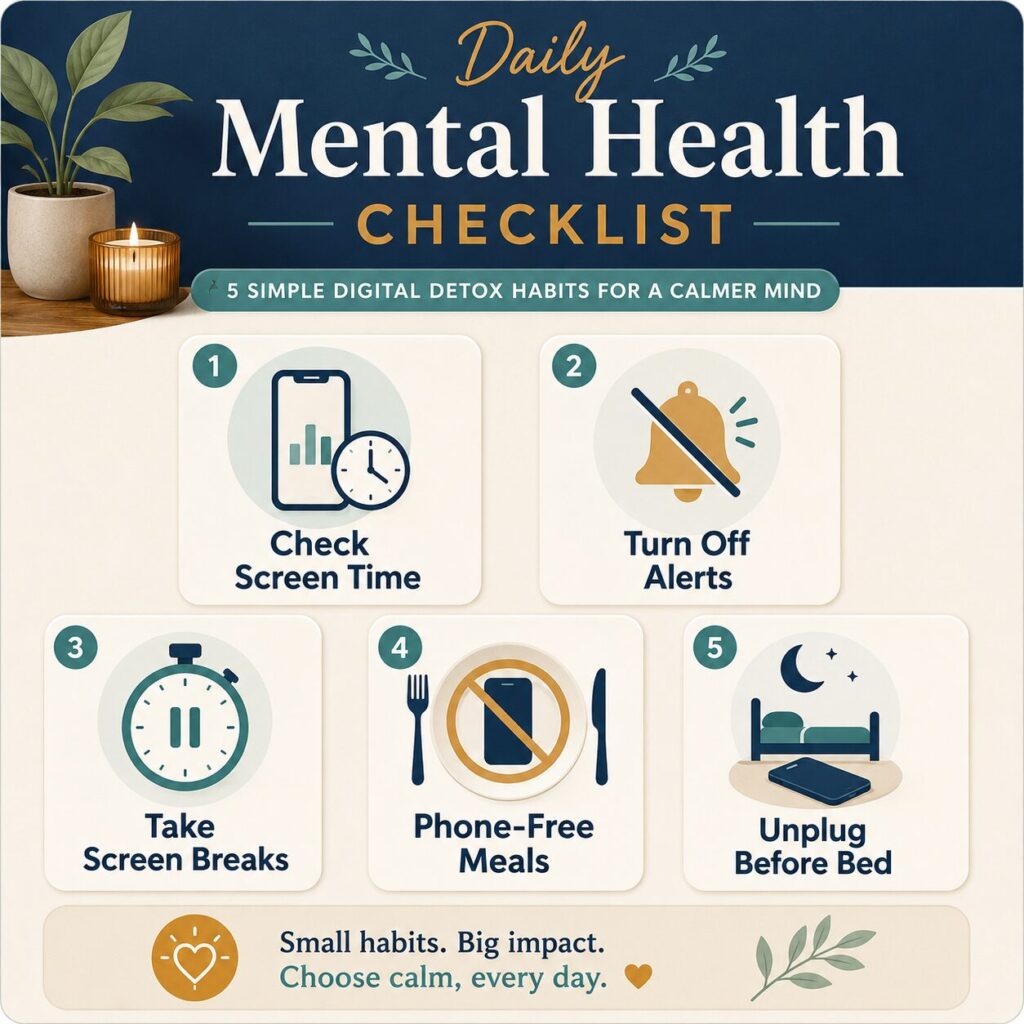
Sample Daily Mental Health Checklist for Digital Detoxing
Use this as a simple starting point.
| Checklist Item | Why It Helps |
|---|---|
| Check screen time once today | Builds awareness without guessing |
| Turn off one distracting notification | Reduces attention interruptions |
| Take one 10-minute screen break | Gives your mind a reset |
| Keep phone away during one meal | Supports presence and connection |
| Avoid phone 30 minutes before bed | Reduces late-night stimulation |
| Replace scrolling with one offline habit | Builds a healthier routine |
| Write one sentence about how you feel | Connects screen habits to mood |
Common Mistakes and Myths About Digital Detoxing
Myth 1: Digital Detoxing Means Quitting the Internet
Digital detoxing does not have to mean going offline completely. For most people, it means using screens with better boundaries.
Myth 2: All Screen Time Is Bad
Not all screen time is equal. A video call with family is different from two hours of stressful scrolling. A work task is different from compulsive app checking.
Myth 3: A Checklist Has to Be Perfect
A good checklist is one you can repeat. Missing a day does not mean you failed. It means you restart the next day.
Myth 4: Deleting Apps Fixes Everything
Deleting apps may help, but it does not always address the emotional trigger behind the habit. The deeper question is often, “What am I reaching for this app to escape, avoid, or feel?”
Expert Insights About a Daily Mental Health Checklist
The biggest lesson I have learned is that digital detoxing is not just about less screen time. It is about better attention.
Two people can spend the same amount of time online and have different outcomes.
One person may use technology to learn, work, connect, and create. Another may use it in a way that increases comparison, distraction, and stress.
That is why I prefer asking better questions instead of only counting minutes.
Helpful questions include:
- Did this screen time serve a purpose?
- Did it help me or drain me?
- Did I choose it, or did I fall into it?
- Did I avoid something important by scrolling?
- Did I make space for real rest today?
Research on digital detox interventions suggests they may help with depressive symptoms and problematic internet use, but effects on broader well-being are more mixed.
That is an important distinction. A checklist can support healthier habits, but it should not be presented as a guaranteed mental health solution.
Best Practices for Digital Detoxing Without Feeling Overwhelmed
Start small. Pick one habit for the first week.
Try these practical tips:
- Keep your phone out of reach during focused work.
- Use grayscale mode if colorful apps pull you in.
- Move distracting apps off your home screen.
- Set app limits for your biggest time-wasters.
- Replace morning scrolling with water, light, prayer, stretching, or journaling.
- Use a real alarm clock if your phone keeps pulling you into bedtime scrolling.
- Schedule one daily offline block, even if it is only 10 minutes.
- Do not use digital detoxing as punishment. Use it as self-respect.
The goal is not to become anti-technology. The goal is to have a healthy technology use.
People Also Ask:
What should be included in a daily mental health checklist?
A daily mental health checklist can include hydration, movement, sleep habits, screen breaks, journaling, meal reminders, quiet time, and emotional check-ins. For digital detoxing, include screen time review, notification limits, phone-free meals, bedtime phone boundaries, and one offline replacement habit. Keep it simple enough to repeat daily.
How do I start digital detoxing?
Start digital detoxing by choosing one screen habit to change. For example, stop using your phone during meals or put it away 30 minutes before bed. Track how you feel before and after. Small changes are easier to maintain than extreme rules that do not fit real life.
Is digital detoxing good for mental health?
Digital detoxing may support mental wellness for some people by reducing overstimulation, comparison, and mindless scrolling. Some studies suggest digital detox interventions may help reduce problematic internet use and depressive symptoms, but results vary. It is best viewed as a supportive habit, not a medical treatment.
How long should a digital detox last?
A digital detox can last 10 minutes, one evening, one day, a weekend, or longer. The best length depends on your lifestyle and responsibilities. For daily mental wellness, short and repeatable breaks often work better than rare extreme detoxes.
What is the best time of day to avoid screens?
Many people benefit from reducing screen use in the morning and before bed. Morning phone use can shape your attention early, while bedtime scrolling can make it harder to wind down. A 30 to 60 minute screen buffer before bed may support better sleep habits for some people.
Can I digital detox if I need my phone for work?
Yes. Digital detoxing does not require quitting your phone. You can keep work tools available while limiting nonessential apps, notifications, and personal scrolling. Use app folders, focus mode, notification controls, and scheduled breaks to separate necessary screen use from mindless use.
Why do I keep checking my phone so much?
Phone checking can become a habit because it gives quick stimulation, distraction, connection, or relief from boredom. App design also encourages repeat use through notifications, feeds, and rewards. A checklist helps you notice the trigger before you automatically open another app.
What can I do instead of scrolling?
Try a short walk, journaling, stretching, reading, drinking water, cleaning one small area, praying, sitting outside, or calling someone. The best replacement is simple, available, and calming. If the replacement habit is too complicated, you probably will not use it consistently.
Conclusion
A daily mental health checklist for digital detoxing is not about rejecting technology. It is about building a healthier relationship with it.
The most useful checklist helps you notice your screen patterns, reduce unnecessary interruptions, protect your sleep, and create more offline space in your day.
Start small. Choose one habit. Watch how it affects your focus, mood, and sense of calm.
Digital wellness is not about being perfect. It is about becoming more aware, more intentional, and more present in your own life.
Non-Clinical Disclaimer
This article is for educational and informational purposes only. It is based on personal experience, general wellness information, and practical lifestyle ideas. It is not medical advice, mental health treatment, therapy, diagnosis, or a substitute for support from a licensed professional.
About the Author
Kevin Mack is the founder of The Mental Health Blogger and a longtime online writer with over 16 years of content publishing experience. He writes from a lived-experience perspective, focusing on practical, non-clinical mental wellness topics that help readers build healthier daily habits, reduce overwhelm, and better understand everyday emotional wellness.
Sources and References
- Pratt Institute, Digital Well-Being: Mindful Technology Use
A helpful non-clinical guide explaining digital well-being as reflection, healthy boundaries, and more intentional technology use.
https://www.pratt.edu/administrative-departments/student-affairs/health-wellness/resilience-wellness-and-well-being-center/resources/start-your-digital-wellbeing-journey/ - Children and Screens, Digital Detox
A reader-friendly resource about taking screen-free breaks, spending more time offline, and noticing what feels better without constant device use.
https://www.childrenandscreens.org/learn-explore/research/digital-detox/ - Be Well, Digital Wellness for Parents and Caregivers
A practical wellness resource with simple ideas like screen-free mealtimes, balancing device time, and making space for offline activities.
https://bewell.ny.gov/digital-wellness-parents-and-caregivers - HealthyChildren.org, How to Build Healthy Digital Habits: 5 Tips for Families
A non-clinical family-friendly guide from the American Academy of Pediatrics with tips on screen-free spaces, do-not-disturb times, and tracking digital habits.
https://www.healthychildren.org/English/family-life/Media/Pages/how-to-build-healthy-digital-habits-tips-for-families.aspx - Second Step, Mindful Tech: Balancing Screen Time and Well-Being
A practical article about mindful technology use, screen time balance, emotional growth, and healthy digital habits.
https://www.secondstep.org/resources/blog/mindful-tech-balancing-screen-time-and-well-being
Related Articles from MentalHealthBlogger.com
- Digital Wellness Tools for Quick Daily Mental Health Breaks at Your Desk
https://www.mentalhealthblogger.com/digital-wellness-tools-for-quick-daily-mental-health-breaks-at-your-desk/
Best fit because it directly connects to digital wellness, screen breaks, focus resets, and daily mental health habits. - How to Stop Overthinking What You Say to People: 6 Ways to Quiet Post-Social Anxiety
https://www.mentalhealthblogger.com/how-to-stop-overthinking-what-you-say-to-people/
Good related article for readers who use scrolling, phone checking, or online distraction after social stress.