
A Simple Daily Habit to Clear Mental Clutter, Improve Focus, and Start Your Morning with Intention in Just Five Minutes

By Kevin Mack’s Mental Wellness Editorial Team | Updated June 13, 2026
Written by a wellness content specialist with years of experience researching mindfulness habits, journaling techniques, productivity routines, and practical mental clarity strategies.
Quick Answer
How to Start a 5-Minute Morning Journaling Routine for Mental Clarity
To start a 5-minute morning journaling routine for mental clarity, set aside five uninterrupted minutes after waking up, use a simple journal or notebook, and follow a consistent structure such as gratitude, priorities, and intentions. Focus on clarity rather than perfection, and aim to write every morning rather than writing a large amount.
Contents
- 1 Key Takeaways
- 2 Introduction
- 3 What Is a 5-Minute Morning Journaling Routine for Mental Clarity?
- 4 Why Does Morning Journaling Matter for Mental Clarity?
- 5 How Do You Start a 5-Minute Morning Journaling Routine?
- 6 What Are the Best Morning Journal Prompts for Beginners?
- 7 Common Mistakes People Make When Starting a Morning Journaling Habit
- 8 Morning Journaling vs Brain Dump Journaling
- 9 Expert Insights About Morning Journaling
- 10 Best Practices and Practical Tips
- 11 People Also Ask
- 12 Conclusion
- 13 About the Author
- 14 Medical Disclaimer
- 15 Sources and References
Key Takeaways
- A 5-minute morning journaling routine can help organize thoughts before the day begins.
- Simple prompts work better than long, complicated writing exercises.
- Consistency matters more than writing a lot.
- Morning journaling can improve focus, self-awareness, and daily intention setting.
- A structured format reduces decision fatigue and makes journaling easier to maintain.
- Starting small often leads to a sustainable long-term habit.
Introduction
A 5-minute morning journaling routine helps clear mental clutter and improve focus at the start of your day. Learn how to build a simple, effective journaling habit using easy prompts, practical steps, and a structured routine for better mental clarity and daily intention setting.
If you’ve ever woken up with a busy mind, a long to-do list, or a feeling of mental clutter, you may have wondered, “How do I start a 5-minute morning journaling routine for mental clarity?”
The good news is that you do not need a fancy notebook, extensive writing skills, or an hour of free time.
In my experience, some of the most effective journaling sessions are also the shortest.
Spending just five focused minutes each morning can create a sense of direction before emails, social media, work demands, and daily distractions begin competing for attention.
A simple journaling routine can help you slow down, organize your thoughts, identify priorities, and start the day with greater awareness.
What Is a 5-Minute Morning Journaling Routine for Mental Clarity?
A 5-minute morning journaling routine is a brief daily writing practice completed shortly after waking up.
Its purpose is not to create polished writing. Instead, it helps clear mental clutter and create focus for the day ahead.
Unlike traditional journaling, which may involve lengthy reflections, a five-minute journaling habit focuses on simplicity and consistency.
Common elements include:
- Gratitude reflections
- Daily priorities
- Personal intentions
- Emotional check-ins
- Brain dumps of lingering thoughts
The goal is to move thoughts from your mind onto paper so they feel more organized and manageable.
Why Does Morning Journaling Matter for Mental Clarity?
Mental clarity is often disrupted by competing thoughts, unfinished tasks, and information overload.
Morning journaling creates a brief pause before daily responsibilities begin.
It Helps Reduce Mental Clutter
Writing down thoughts can make them feel less overwhelming. Instead of trying to remember everything, you create an external record.
The American Psychological Association notes that structured reflective practices like journaling can help reduce stress and improve emotional regulation, making it a useful tool for mental clarity and daily grounding.
It Encourages Intentional Living
Many people react to their day rather than directing it. Journaling helps identify what matters most before distractions take over.
It Creates a Consistent Morning Ritual
Small routines often create a sense of stability. A predictable journaling habit can become an anchor for the rest of your morning.
How Do You Start a 5-Minute Morning Journaling Routine?
The easiest approach is to keep the process extremely simple.
Step 1: Choose a Dedicated Journal
Select any notebook, journal, or digital note-taking app.
Avoid spending too much time searching for the perfect journal. The best journal is the one you actually use.
Step 2: Write Immediately After Waking Up
Attach journaling to an existing habit.
Examples include:
- After brushing your teeth
- After making coffee
- Before checking your phone
- Before opening email
Habit stacking increases consistency.
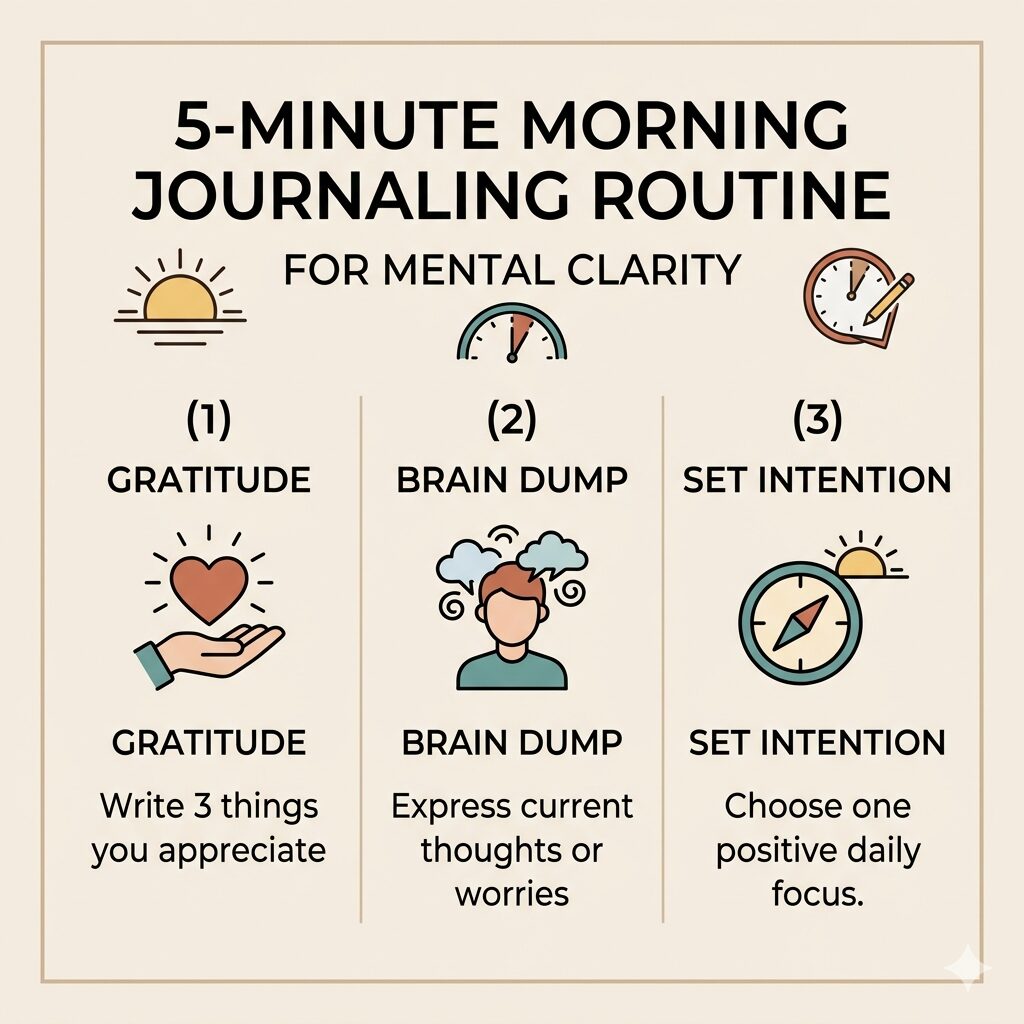
Step 3: Use a Simple Three-Part Structure
For years, I have found that simple frameworks work better than complicated prompts.
Try this format:
What am I grateful for today?
Write one to three things.
What are my top priorities today?
List one to three important tasks.
How do I want to show up today?
Choose a quality such as:
- Calm
- Focused
- Patient
- Confident
- Present
Step 4: Keep Writing Time Limited
Set a timer for five minutes.
The goal is not to write more.
The goal is to show up consistently.
Step 5: Repeat Daily
Consistency builds momentum.
Even a two-minute entry is better than skipping the habit entirely.
Watch: A Simple 5-Minute Morning Journaling Routine Video
What Are the Best Morning Journal Prompts for Beginners?
If you struggle to know what to write, use these simple prompts:
- What is one thing I am grateful for today?
- What is my most important task today?
- What is currently occupying my mind?
- What would make today successful?
- What do I need less of today?
- What do I need more of today?
- How do I want to feel today?
- What is one small win I can create today?
These prompts encourage self-reflection without becoming overwhelming.
Common Mistakes People Make When Starting a Morning Journaling Habit
Trying to Write Too Much
Many beginners assume they need several pages each morning.
In reality, a few meaningful sentences are often enough.
Waiting for Inspiration
Journaling works best as a routine rather than a mood-based activity.
Write even when you do not feel inspired.
Being Too Critical
Your journal is not a school assignment.
Spelling, grammar, and writing quality do not matter.
Skipping Days After Missing One Session
One missed day does not ruin the habit.
Simply continue the next morning.
Morning Journaling vs Brain Dump Journaling
| Morning Journaling | Brain Dump Journaling |
|---|---|
| Structured format | Free-form writing |
| Focuses on intention | Focuses on mental release |
| Usually brief | Can be longer |
| Often includes gratitude | Often includes worries and concerns |
| Creates direction | Creates emotional unloading |
Both methods can support mental clarity.
Many people combine them depending on their needs.
Expert Insights About Morning Journaling
One pattern I consistently notice is that people often overestimate the amount of journaling required to see benefits.
The real value comes from consistency, not volume.
A five-minute routine works because it lowers resistance. Most people can find five minutes.
Few people can consistently find thirty.
Another important observation is that journaling often becomes more effective when readers stop treating it as a productivity tool and start treating it as a daily conversation with themselves.
Mental clarity frequently comes from noticing your thoughts rather than trying to control every one of them.
Best Practices and Practical Tips
- Keep your journal visible.
- Use the same location every morning.
- Write before checking social media.
- Focus on progress, not perfection.
- Use prompts when you feel stuck.
- Keep entries short and manageable.
- Review past entries occasionally.
- Pair journaling with coffee, tea, or another morning ritual.
What to Avoid
- Overcomplicating the process
- Buying excessive journaling supplies
- Comparing your journal to others
- Expecting immediate life-changing results
- Turning journaling into another stressful task
People Also Ask
Is 5 minutes of journaling enough?
Yes. Five minutes is often enough to identify priorities, release mental clutter, and establish daily intentions. Consistency matters more than duration. Many successful journaling habits begin with just a few minutes each morning.
What should I write in a morning journal?
Start with gratitude, daily priorities, and intentions. You can also write about your current thoughts, goals, emotions, or anything occupying your attention. Simplicity is often most effective.
Does morning journaling help with focus?
Many people find that morning journaling improves focus because it helps organize thoughts before distractions arise. Writing priorities on paper can create greater awareness of what deserves attention throughout the day.
Should I journal before or after breakfast?
Either option can work. However, journaling before checking your phone, email, or social media often helps preserve mental clarity and reduces external distractions.
Can I use a journaling app instead of paper?
Yes. Digital journals, note-taking apps, and paper notebooks can all be effective. The best option is the one you will consistently use.
What is the best time to journal in the morning?
The best time is usually within the first hour after waking up. Many people journal immediately after making coffee, stretching, or completing another simple morning habit.
How long does it take to build a journaling habit?
Habit formation varies from person to person. Many people notice a routine feeling more natural after several weeks of consistent practice. Focus on showing up daily rather than achieving perfection.
What if I do not know what to write?
Use prompts. Questions such as “What matters most today?” or “How do I want to feel today?” can provide a simple starting point and reduce blank-page anxiety.
Conclusion
If you’re wondering how to start a 5-minute morning journaling routine for mental clarity, the simplest answer is to begin small and stay consistent.
You do not need a perfect notebook, a complicated system, or lengthy writing sessions.
Five focused minutes can help organize your thoughts, clarify priorities, and create a more intentional start to your day.
Over time, this simple practice may become one of the most valuable parts of your morning routine.
Start tomorrow with a notebook, a timer, and a few honest sentences. Mental clarity often begins with putting your thoughts on paper.
About the Author
Kevin Mack is a mental wellness content creator and researcher who writes about mindfulness, emotional well-being, stress management, personal growth, and healthy daily habits. He focuses on creating clear, practical, and evidence-informed content that helps readers build simple routines for greater mental clarity, resilience, and overall well-being.
Medical Disclaimer
This article is for educational and informational purposes only and is not intended as medical, mental health, or professional advice. The content should not be used to diagnose, treat, cure, or prevent any condition. If you have concerns about your mental health, emotional well-being, or overall health, consult a qualified healthcare professional.
Sources and References
Harvard Health Publishing – Gratitude and Mental Well-Being
Explains how gratitude practices can improve mood, emotional balance, and overall mental health.
https://www.health.harvard.edu/healthbeat/gratitude-the-benefits-of-being-thankful
American Psychological Association (APA) – Stress Management Resources
Provides research-based information on how stress affects the mind and body, and how reflective practices like journaling can support emotional regulation.
https://www.apa.org/topics/stress
University of Rochester Medical Center – Journaling for Mental Health
Offers educational insights into how journaling can help process emotions, reduce stress, and improve mental clarity.
https://www.urmc.rochester.edu/health-wellness/blogs/journaling-for-mental-health.aspx
Greater Good Science Center (UC Berkeley) – Science of Well-Being
Shares research-backed findings on gratitude, mindfulness, and habits that improve emotional resilience and daily well-being.
https://greatergood.berkeley.edu
Visit the Mental Health Blogger for more practical mindfulness tips, journaling routines, and daily mental clarity strategies to support your well-being.
Mayo Clinic – Stress Management and Mindfulness
Provides guidance on healthy coping strategies for stress, including mindfulness-based techniques that align with journaling practices.
https://www.mayoclinic.org/healthy-lifestyle/stress-management