
A practical, compassionate guide to communication, sensory needs, emotional safety, and building a stronger neurodiverse relationship.

By Kevin Mack, Mental Health Blogger Founder and Lived-Experience Mental Health Writer
Kevin Mack writes educational, non-medical mental health and neurodiversity content from a lived-experience perspective.
Contents
- 1 Key Takeaways
- 2 Introduction
- 3 Quick Answer
- 4 How to Support an Autistic Partner
- 5 What Does It Mean to Support a Partner Who Is on the Autism Spectrum?
- 6 Why Supporting an Autistic Partner Matters in a Relationship
- 7 What Are Common Signs Your Autistic Partner May Need Support?
- 8 Why Does an Autistic Partner Communicate Differently?
- 9 How Can I Support a Partner Who Is on the Autism Spectrum Step by Step?
- 10 Common Mistakes and Myths About Supporting an Autistic Partner
- 11 Expert Insights About Neurodiverse Relationships
- 12 Best Practices for Supporting an Autistic Partner
- 13 People Also Ask:
- 14 Conclusion
- 15 Sources and References
- 16 About the Author
- 17 Medical Disclaimer
Key Takeaways
- Supporting a partner who is on the autism spectrum starts with respect, patience, and clear communication.
- Autism can affect communication style, sensory needs, routines, social energy, and emotional processing.
- The goal is not to “fix” your partner. The goal is to understand how they experience the world.
- Sensory overload, masking, shutdowns, and direct communication can be misunderstood in relationships.
- Healthy support includes boundaries, honest conversations, predictable routines, and mutual emotional care.
- Every autistic person is different, so the best support comes from asking your partner what actually helps them.
Introduction
Supporting a partner on the autism spectrum starts with clear communication, sensory awareness, patience, and mutual respect. Learn practical, non-medical ways to understand your autistic partner, reduce misunderstandings and build a healthier neurodiverse relationship.
Loving someone on the autism spectrum can teach you a deeper kind of patience, communication, and emotional awareness.
If you are asking, “How can I support a partner who is on the autism spectrum?” the clearest answer is this: learn how your partner communicates, respect their sensory needs, avoid taking every difference personally, and build a relationship where both people feel safe being honest.
I have learned that support in a neurodiverse relationship is not about walking on eggshells. It is about paying attention.
It is about asking better questions. It is about realizing that love does not always look loud, expressive, or emotionally obvious.
Sometimes love looks like giving your partner quiet time after a crowded event.
Sometimes it looks like saying exactly what you mean.
Sometimes it looks like not forcing eye contact, small talk, or emotional performance.
This article is a non-medical guide for partners who want to be supportive, respectful, and realistic.
Quick Answer
How to Support an Autistic Partner
To support a partner who is on the autism spectrum, communicate clearly, respect sensory needs, learn their routines, avoid pressuring them to mask, and ask what support feels helpful to them. Autism affects people differently, so the strongest relationship support comes from patience, curiosity, consistency, and mutual respect.
What Does It Mean to Support a Partner Who Is on the Autism Spectrum?
Supporting an autistic partner means understanding that autism is not a personality flaw, a lack of love, or a relationship problem by itself.
Autism is commonly understood as a lifelong neurodevelopmental difference that can affect communication, social interaction, sensory processing, routines, focus, and emotional expression. Autistic people are not all the same.
One autistic person may need quiet after social events. Another may love social time but struggle with sudden changes. One may speak very directly. Another may mask their discomfort for years.
In a relationship, this matters because many misunderstandings happen when one partner assumes the other partner is being rude, cold, distant, dramatic, or uninterested.
For example, an autistic partner may:
- Need extra time to process emotional conversations
- Prefer direct words over hints
- Feel overwhelmed by noise, lights, textures, or crowds
- Depend on routines to feel grounded
- Show affection through actions more than words
- Need solitude after social interaction
- Struggle to explain overload while it is happening
None of these automatically mean they do not care.
A better question is not, “Why are they acting like this?” A better question is, “What is their nervous system dealing with right now?”
Why Supporting an Autistic Partner Matters in a Relationship
Supporting a partner on the autism spectrum matters because misunderstanding can slowly damage trust.
A partner who feels constantly corrected may start masking more. A partner who feels ignored may become resentful.
A partner who feels overwhelmed may withdraw or a partner who does not understand autism may misread neutral behavior as rejection.
In my own observation, many relationship problems are not caused by autism itself. They are caused by unclear expectations, emotional guessing, sensory stress, and pressure to act “normal.”
Support helps because it creates:
- More emotional safety
- Less conflict caused by misinterpretation
- Better communication
- More realistic expectations
- More room for both partners to be themselves
This does not mean the non-autistic partner should ignore their own needs. A healthy neurodiverse relationship should support both people.
You can be understanding without becoming invisible.
What Are Common Signs Your Autistic Partner May Need Support?
These signs do not prove anything by themselves, but they can help you notice when your partner may be stressed, overloaded, or struggling to communicate.
They Become Quiet After Social Situations
Some autistic people use a large amount of energy to manage social settings.
This can include reading facial expressions, filtering noise, tracking conversation, forcing eye contact, and trying not to appear uncomfortable.
Afterward, they may seem distant or emotionally flat.
That does not always mean they are upset with you. They may simply be recovering.
They Prefer Direct Communication
Hints, vague statements, sarcasm, and indirect emotional signals can create confusion.
Instead of saying, “You should know what I mean,” try saying, “I felt hurt when that happened, and I need reassurance.”
Clear communication is not less romantic. For many autistic people, it is more respectful.
They Get Overwhelmed by Sensory Input
Sensory overload can happen when lights, sounds, smells, textures, crowds, or movement become too much.
Your partner may need to leave a store, turn down music, avoid certain fabrics, sit away from noise, or spend time in a quiet room.
This is not being difficult. It may be a real need.
They Struggle With Sudden Changes
Some autistic people feel more secure when plans are predictable. A last-minute change may seem small to you but feel stressful to them.
Support can be as simple as giving advance notice, explaining the change clearly, and allowing time to adjust.
They Mask Their Discomfort
Masking means hiding autistic traits to fit social expectations. It can include forcing eye contact, copying social behavior, suppressing stimming, or pretending to be fine.
One autistic adult described it this way in a community discussion: “I can look okay on the outside, but inside I am counting the minutes until I can be alone.”
That kind of experience is easy to miss if you only judge by appearance.
Why Does an Autistic Partner Communicate Differently?
Autistic communication differences can come from several factors, including sensory processing, social interpretation, emotional regulation, routine needs, and past experiences of being misunderstood.
Some autistic people speak very literally. Some need time before answering emotional questions.
Some communicate better through writing than face-to-face conversation. Some show love through consistency, problem-solving, loyalty, or shared interests instead of dramatic emotional expression.
A common mistake is assuming different means wrong.
For example:
- Direct speech is not always rudeness.
- Silence is not always rejection.
- Need for space is not always lack of love.
- Repetition is not always stubbornness.
- A flat tone is not always anger.
The key is to learn your partner’s patterns instead of forcing them into a one-size-fits-all relationship script.
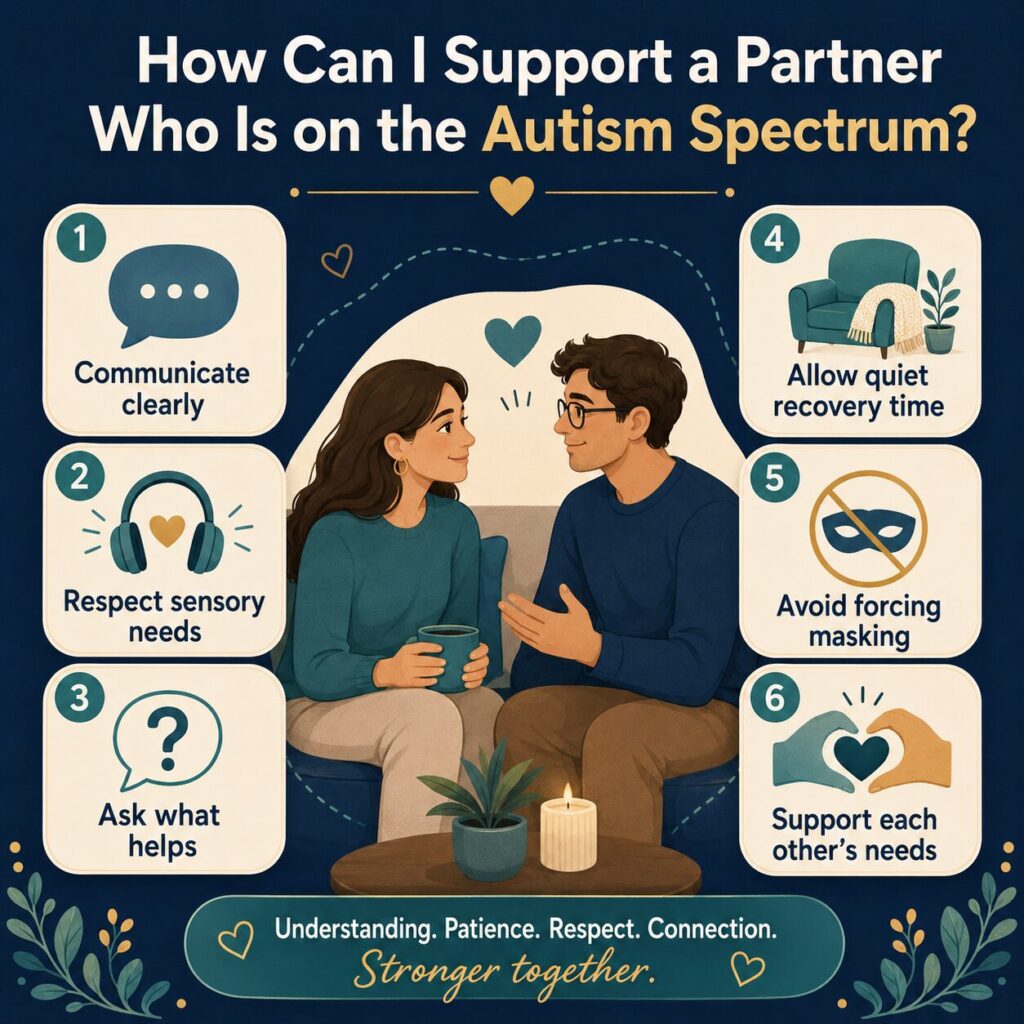
How Can I Support a Partner Who Is on the Autism Spectrum Step by Step?
Step 1: Ask What Support Looks Like to Them
Do not assume you already know.
Ask simple questions like:
- “What helps when you feel overwhelmed?”
- “Do you want advice, comfort, or quiet?”
- “How can I tell when you need space?”
- “Is there anything I do that makes overload worse?”
- “Would texting be easier than talking during conflict?”
These questions show respect. They also prevent guessing.
Step 2: Use Clear and Kind Communication
Clear communication is one of the strongest tools in a neurodiverse relationship.
Try to say what you mean without turning every issue into a test.
Instead of:
“You never care how I feel.”
Try:
“I felt alone earlier. Can we talk for ten minutes after dinner?”
Instead of:
“Forget it. It does not matter.”
Try:
“I am upset, but I need a little time before I explain.”
This helps both partners stay grounded.
Step 3: Respect Sensory Needs Without Making Them a Big Deal
If your partner avoids loud restaurants, bright stores, strong smells, or crowded rooms, try not to shame them for it.
You can plan around sensory needs by:
- Choosing quieter seating
- Keeping backup plans
- Bringing headphones
- Leaving events early when needed
- Creating a calm space at home
- Checking in before social plans
Small adjustments can prevent major stress.
Step 4: Learn the Difference Between Space and Rejection
Some autistic people need alone time to reset. This may be especially true after work, social events, conflict, travel, or sensory overload.
The key is to create a plan.
For example:
“When you need space, can you say, ‘I need quiet time, but we are okay’? That would help me not panic.”
This respects both partners. One gets recovery time. The other gets reassurance.
Step 5: Do Not Force Masking
If your partner stims, avoids eye contact, needs routine, or communicates differently, try not to make them feel embarrassed.
Masking may help someone get through a public situation, but constant masking can be exhausting.
A supportive relationship should be one place where your partner does not have to perform all the time.
Step 6: Take Care of Your Own Needs Too
Supporting an autistic partner does not mean ignoring yourself.
You still need affection, honesty, shared responsibility, and emotional connection. You are allowed to have needs. The goal is to communicate those needs in a way that is clear, fair, and realistic.
Healthy support sounds like:
“I want to understand your needs, and I also want us to find a way to stay connected.”
That is very different from blame.
Related Video
For a real-life discussion about autism and intimate relationships, watch this helpful video from Reframing Autism.
Common Mistakes and Myths About Supporting an Autistic Partner
| Myth or Mistake | What to Understand Instead |
|---|---|
| “They do not care because they do not show emotion like I do.” | Autistic people may express care differently. Look for patterns, actions, and direct communication. |
| “I should push them out of their comfort zone.” | Growth matters, but pressure can increase stress. Work together on realistic steps. |
| “Autism explains everything.” | Autism may explain some patterns, but both partners are still responsible for respect and communication. |
| “If they loved me, they would just know what I need.” | Clear communication helps many relationships, especially neurodiverse ones. |
| “Sensory overload is just an excuse.” | Sensory overload can feel intense and real. Support starts with taking it seriously. |
| “I have to give up my own needs.” | A healthy relationship supports both people, not just one partner. |
Expert Insights About Neurodiverse Relationships
A helpful way to understand autism in relationships is to separate intent from impact.
Your partner may not intend to sound blunt, but the impact may still hurt.
You may not intend to overwhelm them with questions, but the impact may still be stressful.
Healthy couples do not stop at intent. They talk about impact without turning it into an attack.
For example:
“I know you were not trying to hurt me. The way it came out still felt sharp. Can we try that conversation again?”
Or:
“I know you need answers right now, but I am overloaded. I can talk after I reset.”
This kind of language protects both people.
It avoids blame while still being honest.
Best Practices for Supporting an Autistic Partner
Here are practical ways to make daily life easier.
- Create predictable routines. Even small routines can lower stress.
- Use direct words. Say what you mean with kindness.
- Offer choices. “Do you want to talk now or after dinner?”
- Respect recovery time. Alone time can be regulation, not rejection.
- Plan sensory-friendly dates. Quiet walks, home dinners, museums at slow hours, or calm coffee shops may work better than crowded events.
- Use written communication when needed. Texting can reduce pressure during emotional topics.
- Do not shame stimming or quietness. These may be ways your partner self-regulates.
- Check in after conflict. A simple repair conversation can prevent emotional distance.
- Learn their affection style. Love may show up as loyalty, problem-solving, honesty, shared routines, or remembering details.
- Keep mutual respect at the center. Autism should never be used as an insult, and support should never erase your needs.
People Also Ask:
Is it hard to date someone on the autism spectrum?
Dating someone on the autism spectrum can have challenges, but it can also be deeply meaningful. The hardest parts often come from misunderstood communication, sensory needs, routine differences, and emotional assumptions. Clear expectations help. Many autistic people are loyal, thoughtful, honest, and deeply caring partners. The relationship works best when both people are willing to learn each other’s needs.
How do autistic people show love in relationships?
Autistic people may show love through honesty, consistency, shared interests, acts of service, problem-solving, loyalty, deep attention, or spending quiet time together. Some may not use emotional words often, but that does not mean they lack feeling. The best approach is to ask your partner how they express love and what helps them feel loved in return.
What should I avoid saying to an autistic partner?
Avoid saying things that shame their needs, such as “You are too sensitive,” “Just act normal,” “Why are you always like this?” or “You should know what I mean.” These phrases can create defensiveness and hurt. Instead, use clear and respectful language. Say what you need without attacking who they are.
How can I help my autistic partner during sensory overload?
During sensory overload, reduce input and avoid too many questions. Lower noise, dim lights, give space, or help them leave the environment if they want that. Ask ahead of time what helps because every person is different. Some people want silence. Others want pressure, a familiar object, headphones, or a quiet room.
Why does my autistic partner need so much alone time?
Alone time can help an autistic person recover from social, emotional, or sensory stress. It does not always mean they are mad, distant, or uninterested. A helpful solution is to agree on a reassurance phrase, such as “I need quiet time, but we are okay.” That gives one partner space and the other partner emotional clarity.
Can a relationship work if one partner is autistic and the other is not?
Yes, a relationship can work when both people are respectful, honest, and willing to understand each other. The relationship may require more direct communication, sensory awareness, and planning. It also requires both partners to feel heard. Neurodiverse relationships work best when differences are treated as information, not personal failures.
How do I talk about problems without overwhelming my autistic partner?
Choose a calm time, be specific, and focus on one issue at a time. Avoid emotional guessing, rapid questions, sarcasm, or vague accusations. You might say, “I want to talk about what happened yesterday. I am not attacking you. I want us to understand each other better.” This creates a safer conversation.
Should I read about autism if my partner is autistic?
Yes, learning about autism can help, but your partner should not be treated like a textbook example. Read credible sources, listen to autistic voices, and then ask your partner what fits their actual experience. General knowledge is helpful, but personal understanding matters more in a relationship.
Conclusion
Supporting a partner who is on the autism spectrum begins with respect.
You do not need to be perfect. You do not need to understand everything overnight.
But you do need to stay curious, communicate clearly, and stop assuming that different communication means lack of love.
The strongest support often comes from small daily choices.
- Give advance notice.
- Say what you mean.
- Respect sensory limits.
- Allow recovery time.
- Ask what helps.
- Take care of your needs too.
A healthy neurodiverse relationship is not built on one person changing who they are. It is built on both people learning how to feel safe, understood, and respected together.
Sources and References
- CDC: Signs and Symptoms of Autism Spectrum Disorder
Explains common autism-related differences in communication, behavior, learning, movement, and attention.
https://www.cdc.gov/autism/signs-symptoms/index.html - National Institute of Mental Health: Autism Spectrum Disorder
Provides a clear overview of autism as a developmental condition that affects communication, learning, behavior, and social interaction.
https://www.nimh.nih.gov/health/topics/autism-spectrum-disorders-asd - National Autistic Society: What Is Autism?
Offers an autism-informed explanation of how autistic people may experience and interact with the world.
https://www.autism.org.uk/advice-and-guidance/what-is-autism - National Autistic Society: Masking
Explains masking and why autistic people may hide or suppress traits to meet social expectations.
https://www.autism.org.uk/advice-and-guidance/behaviour/masking - Autistic Self Advocacy Network: What We Believe
Provides autistic-led perspectives on communication rights, support, and respect for autistic people.
https://autisticadvocacy.org/about-asan/what-we-believe/
About the Author
Kevin Mack is the founder of The Mental Health Blogger and writes educational, non-medical content about mental health, relationships, emotional wellness, and neurodiversity. He focuses on clear, supportive articles that help readers better understand themselves and the people they care about.
Medical Disclaimer
This article is for educational and informational purposes only. It is not medical advice, diagnosis, or treatment. If you have concerns about autism, mental health, relationships, or emotional well-being, consider speaking with a qualified professional.