
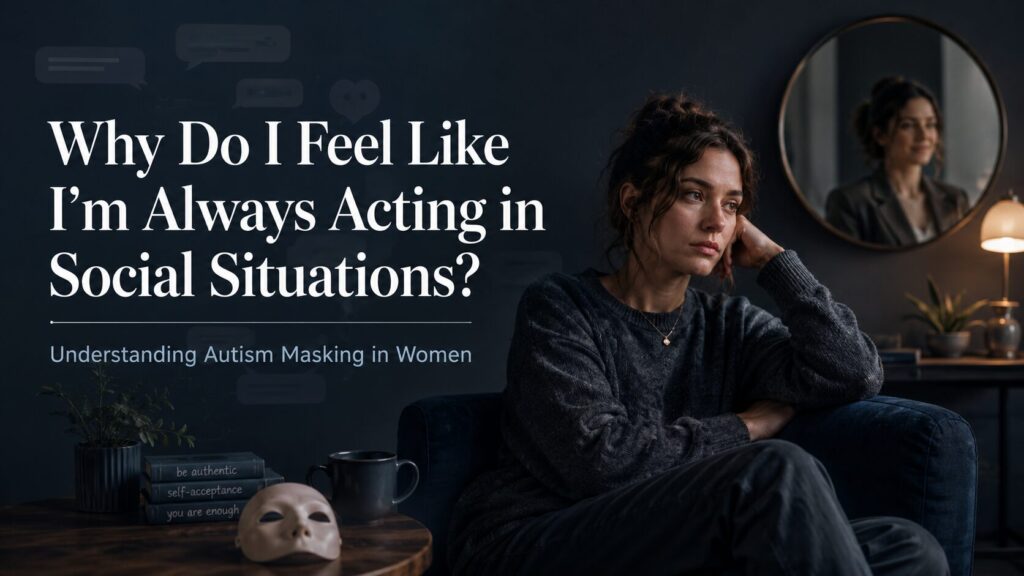
Understanding the hidden effort behind autism masking in women, social performance, and the exhausting feeling of pretending to be okay.
By Kevin Mack | Mental Health Blogger | June 18, 2026 | Written from a non-medical, educational perspective with lived-experience awareness, mental health writing experience, and a focus on clear, practical explanations for readers exploring autism masking.
Feeling like you are always acting in social situations may be a sign of autism masking in women symptoms, especially if you rehearse conversations, copy social behavior, hide discomfort, force eye contact, and feel drained afterward. It can also overlap with anxiety, trauma, ADHD, or long-term people-pleasing.
Contents
- 1 Key Takeaways
- 2 Introduction
- 3 What Is Autism Masking in Women?
- 4 Why Does Autism Masking in Women Matter?
- 5 What Are the Main Autism Masking in Women Symptoms?
- 6 Watch This Related Video:
- 7 Why Do I Feel Like I Am Always Acting Around People?
- 8 Autism Masking vs Social Anxiety vs People-Pleasing
- 9 How to Understand Autism Masking in Real Life
- 10 Common Myths About Autism Masking in Women
- 11 Expert Insights: The “Acting” Feeling Is Often About Self-Monitoring
- 12 Best Practices and Practical Tips
- 13 People Also Ask:
- 14 Conclusion
- 15 About the Author
- 16 Medical Disclaimer
- 17 Sources and References
Key Takeaways
- Feeling like you are “always acting” in social situations can be a common way people describe autism masking, especially in women.
- Autism masking in women symptoms may include rehearsing conversations, copying others, forcing eye contact, hiding sensory discomfort, and feeling exhausted after socializing.
- Masking does not prove someone is autistic by itself. Trauma, anxiety, people-pleasing, ADHD, cultural pressure, and social survival habits can also play a role.
- Many women mask for years because they learned to appear “fine,” helpful, polite, or easygoing even when they felt overwhelmed inside.
- Understanding masking can help you notice patterns, protect your energy, and seek the right kind of support if needed.
Introduction
Feeling like you are always acting in social situations may be linked to autism masking in women symptoms. Learn the signs, causes, examples, and practical ways to understand social masking without judgment.
Feeling like you are always acting in social situations can be confusing, lonely, and exhausting.
When people search for autism masking in women symptoms, they are often trying to understand why they can seem socially capable on the outside but feel tense, scripted, or disconnected on the inside.
I have seen this question come up again and again in mental health and neurodiversity conversations.
A person may look calm at work, friendly at family events, and polite in public.
But privately, they feel like they are performing a role instead of simply being themselves.
This article explains what that “acting” feeling can mean, how it connects to autism masking in women, what signs to look for, and what else might explain it.
This is not a diagnosis guide. It is a clear, non-medical starting point for understanding your own social patterns with more compassion.
What Is Autism Masking in Women?
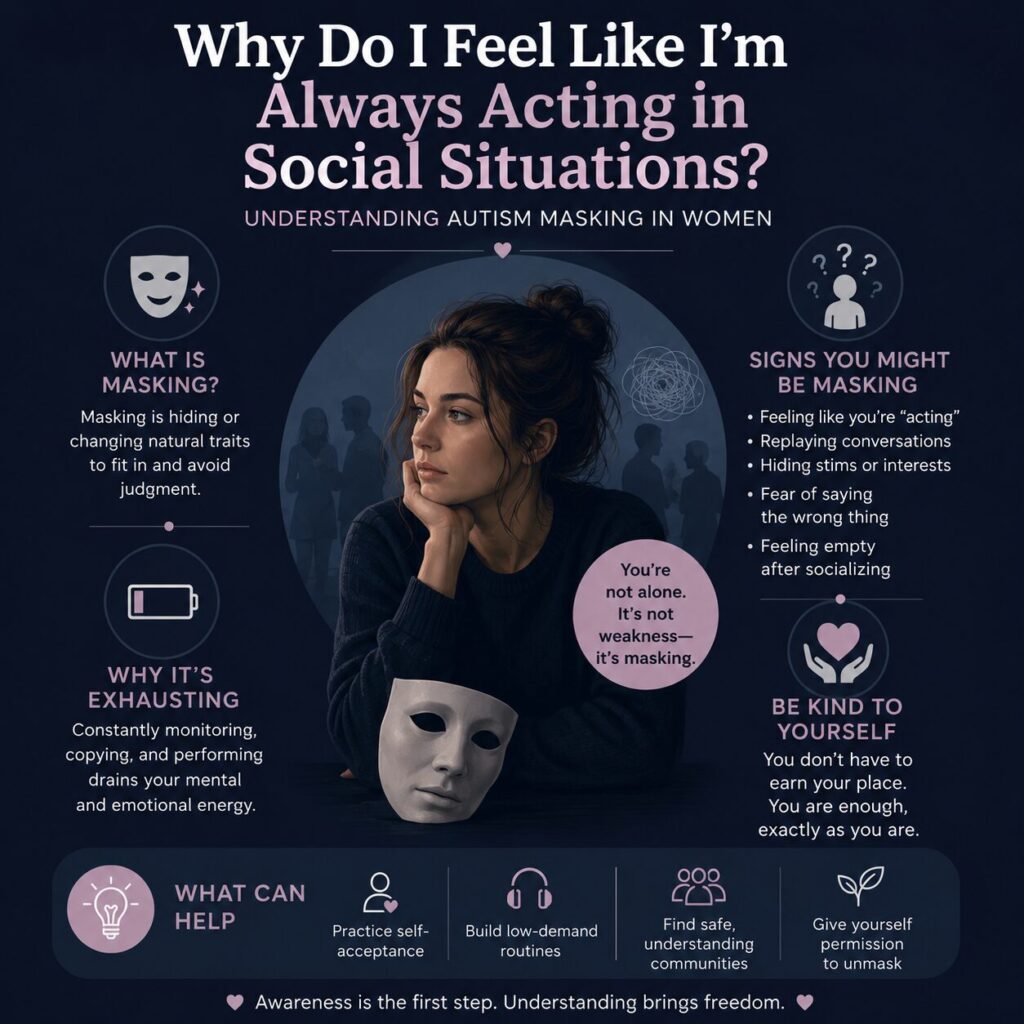
Autism masking means hiding, suppressing, or changing natural autistic traits to appear more socially acceptable or “normal” in public.
For many women, masking may look less obvious than people expect. It may not look like silence, withdrawal, or visible distress.
It may look like being friendly, prepared, high-functioning, responsible, and socially aware.
That is what makes it so hard to recognize.
A woman may learn to:
- Smile at the right moments
- Laugh when others laugh
- Copy the tone or body language of nearby people
- Memorize social scripts
- Force eye contact
- Hide stimming or sensory discomfort
- Push through exhaustion to avoid seeming rude
- Study people carefully to avoid making mistakes
From the outside, she may appear socially skilled. On the inside, she may feel like she is constantly monitoring herself.
That is the heart of the “I feel like I am acting” experience.
Why Does Autism Masking in Women Matter?
Autism masking matters because it can hide real needs.
When someone appears calm, capable, and socially successful, other people may not see the effort underneath.
They may not notice the mental calculations, the sensory overload, the fear of being misunderstood, or the exhaustion that hits later.
This is especially important for women because many girls are socialized early to be polite, agreeable, emotionally aware, and easy to be around.
A girl who learns to copy others well may not be noticed as struggling. She may simply be called shy, sensitive, dramatic, mature, anxious, or “too much in her head.”
Over time, masking can create a painful gap between the outside self and the inside self.
That gap can lead to questions like:
- Why do I feel fake around people?
- Why do I need time alone after simple conversations?
- Why do I rehearse what to say before I say it?
- Why do I feel normal alone but tense around others?
- Why does everyone think I am fine when I feel overwhelmed?
Understanding masking gives language to an experience that many people have blamed on weakness, awkwardness, or personality flaws.
What Are the Main Autism Masking in Women Symptoms?
Autism masking in women symptoms can show up in subtle ways. These signs do not prove autism by themselves, but they can point to patterns worth exploring.
Rehearsing conversations before they happen
You may plan what to say before calling someone, entering a meeting, responding to a text, or seeing family.
This can feel like writing a script in your head. You may prepare safe topics, possible jokes, polite responses, and backup lines in case the conversation changes.
This matters because many people who mask do not feel socially automatic. They may rely on planning to reduce uncertainty.
Copying other people’s behavior
You may notice yourself copying how others speak, dress, laugh, gesture, or respond.
This can happen consciously or automatically. You may pick up another person’s tone because it helps you blend in.
You may even feel like you become a slightly different version of yourself depending on who you are around.
This does not mean you are fake. It may mean you learned social survival through observation.
Forcing eye contact
Many people are taught that eye contact means confidence, honesty, and respect.
For someone who masks, eye contact can feel unnatural, distracting, or physically uncomfortable.
You may force yourself to look at someone’s eyes while silently counting seconds or switching between looking at their eyes, nose, mouth, or forehead.
The outside behavior looks simple. The inside effort can be intense.
Hiding sensory discomfort
You may pretend that lights, sounds, clothing textures, strong smells, crowds, or background noise do not bother you.
This can look like staying quiet in a loud restaurant, wearing uncomfortable clothes to fit in, or sitting through an event while your body feels overloaded.
Many women who mask push through discomfort because they do not want to seem difficult.
Feeling exhausted after socializing
One of the strongest clues is what happens after the social situation ends.
You may need silence, darkness, sleep, alone time, or a long recovery period after a normal conversation, workday, party, phone call, or family visit.
The exhaustion may not come from dislike of people. It may come from performing, filtering, adjusting, and monitoring yourself for hours.
Feeling like you have different “versions” of yourself
You may feel like you have a work version, family version, public version, partner version, and private version.
Everyone adapts somewhat across settings. But masking can feel more extreme. You may feel like the real you only exists when you are alone.
That can become emotionally heavy over time.
Watch This Related Video:
4 Strategies of Masking in Women
For a deeper look at how masking can show up in everyday life, this video explains common masking strategies in women and why they can be easy to overlook. It pairs well with the signs and examples covered in this article.
Why Do I Feel Like I Am Always Acting Around People?
You may feel like you are always acting because your social behavior is being managed instead of flowing naturally.
That can happen for several reasons.
Autism masking
If you are autistic or suspect you may be, acting may come from trying to hide traits that others have judged, misunderstood, or corrected.
You may have learned to perform social normalcy to avoid rejection, bullying, conflict, or being seen as strange.
Social anxiety
Social anxiety can also make people overthink every word, facial expression, and pause.
The difference is that social anxiety often centers on fear of judgment.
Autism masking may include fear of judgment too, but it often also includes sensory strain, social translation, routine disruption, and the effort of decoding unspoken rules.
Trauma or emotional self-protection
Some people learn to act because being authentic once felt unsafe.
If you grew up around criticism, conflict, emotional unpredictability, bullying, or rejection, you may have learned to scan people constantly and adjust yourself to avoid trouble.
That can look similar to masking.
ADHD and social compensation
Some people with ADHD mask impulsivity, distractibility, emotional intensity, forgetfulness, or restlessness.
They may over-prepare, over-apologize, or create a polished social version of themselves to cover internal chaos.
People-pleasing
People-pleasing can create a habit of becoming whoever others need you to be.
This can overlap with autism masking, but it can also exist separately. The key pattern is ignoring your own comfort to maintain approval, peace, or belonging.
Autism Masking vs Social Anxiety vs People-Pleasing
| Pattern | What It May Feel Like | Common Driver | What It Does Not Prove |
|---|---|---|---|
| Autism masking | “I am performing normal social behavior.” | Blending in, decoding social rules, hiding traits | Does not prove autism by itself |
| Social anxiety | “Everyone is judging me.” | Fear of embarrassment or rejection | Does not always mean autism |
| People-pleasing | “I need to keep everyone comfortable.” | Approval, safety, conflict avoidance | Does not always involve neurodivergence |
| Trauma response | “I need to monitor people to stay safe.” | Past emotional harm or instability | Does not mean someone is being fake |
| ADHD masking | “I need to hide how scattered or intense I feel.” | Compensation for attention or regulation struggles | Does not rule autism in or out |
How to Understand Autism Masking in Real Life
Step 1: Notice when the acting feeling shows up
Pay attention to where you feel most performed.
Is it at work? Around family? In groups? During phone calls? On dates? Around authority figures?
Patterns matter. You may discover that some environments require much more effort than others.
Step 2: Track what you hide
Ask yourself what you are trying not to show.
Examples may include:
- Confusion
- Sensory discomfort
- Strong interests
- Need for routine
- Lack of eye contact
- Emotional overwhelm
- Stimming
- Literal thinking
- Fatigue
- Need for quiet
This helps separate general nervousness from specific masking behaviors.
Step 3: Notice the recovery cost
After social situations, ask:
- Do I feel tired or wiped out?
- Do I replay everything I said?
- Do I need silence?
- Do I feel irritated, numb, or disconnected?
- Do I feel relief when I can finally stop performing?
The after-effect often reveals more than the social moment itself.
Step 4: Compare your public self and private self
Think about who you are when nobody is watching.
Do you move differently? Talk differently? Think out loud? Avoid eye contact? Use fewer facial expressions? Dress for comfort? Repeat sounds or movements? Spend time with focused interests?
This is not about judging yourself. It is about learning where you feel most natural.
Step 5: Seek credible information before labeling yourself
It is okay to explore autism, masking, and neurodivergence. It is also wise to stay careful.
Online content can help you find language, but it cannot fully explain your life.
If the topic feels important, consider reading credible sources, listening to autistic women’s experiences, and speaking with a qualified professional if you want a formal evaluation.
Common Myths About Autism Masking in Women
Myth 1: If you are social, you cannot be autistic
This is one of the biggest misunderstandings.
Some autistic women are talkative, friendly, warm, funny, and socially interested.
The question is not only whether they can socialize. The question is how much effort it takes and what it costs afterward.
Myth 2: Masking means someone is being fake
Masking is not the same as lying.
For many people, masking is a learned survival strategy. It may begin as a way to avoid bullying, rejection, punishment, embarrassment, or being misunderstood.
Myth 3: Only autistic people mask
Many people mask parts of themselves.
People may mask because of anxiety, trauma, culture, work expectations, family roles, gender pressure, or fear of judgment.
Autism masking has specific patterns, but masking itself is not exclusive to autism.
Myth 4: Women mask because they are better at social skills
Some women may appear socially skilled because they have practiced intensely.
That does not always mean social interaction feels natural. Sometimes the polished surface hides years of observation, trial and error, and private exhaustion.
Myth 5: Unmasking means suddenly saying everything you think
Unmasking does not mean dropping every filter.
Healthy unmasking is usually gradual. It can mean honoring sensory needs, using more honest communication, choosing safer relationships, and reducing unnecessary performance.
Expert Insights: The “Acting” Feeling Is Often About Self-Monitoring
One of the most useful ways to understand masking is to think of it as constant self-monitoring.
A person may be asking silent questions all day:
- Is my face doing the right thing?
- Did I talk too much?
- Did I sound rude?
- Am I standing normally?
- Should I laugh now?
- Did I make enough eye contact?
- Do they think I am strange?
- Can I leave yet?
That hidden mental workload is easy for others to miss.
In my view, this is why so many people describe masking as acting. Acting requires awareness of audience, timing, tone, body language, and role.
Masking can feel similar because the person is not simply participating. They are performing and directing themselves at the same time.
Research on social camouflaging in autistic adults shows that many autistic people describe masking as a way to manage social expectations, avoid standing out, or appear more socially typical.
Best Practices and Practical Tips
Give yourself permission to notice the pattern
You do not have to diagnose yourself overnight.
Start with noticing. Awareness is useful even before you have a label.
Create low-mask spaces
Look for places where you do not have to perform as much.
This could be time alone, quiet hobbies, supportive friendships, neurodivergent communities, journaling, or online spaces where you feel less judged.
Reduce unnecessary social scripts
Some scripts are useful. They help with work, boundaries, and polite communication.
But not every interaction needs a perfect performance. Try letting small safe moments be more natural.
Protect recovery time
If social situations drain you, plan recovery time without shame.
That may mean quiet time after work, fewer back-to-back plans, lower-sensory environments, or clearer limits around social commitments.
Use plain language when possible
Instead of pretending everything is fine, try simple phrases like:
- “I need a quiet minute.”
- “I process better with time.”
- “Can you send that in writing?”
- “I am listening, even if I am not making much eye contact.”
- “I need to step away and reset.”
These small phrases can reduce the pressure to perform.
Be careful with online self-diagnosis
Online content can be validating, but it can also be incomplete.
Use it as a starting point, not the final answer. A full understanding of yourself may include autism, anxiety, ADHD, trauma, personality patterns, sensory needs, or a combination of experiences.
People Also Ask:
Is feeling like I am acting a symptom of autism masking?
It can be. Many people describe autism masking as feeling like they are acting, performing, or playing a role in social situations. This may include rehearsing conversations, copying others, hiding discomfort, and appearing calm while feeling overwhelmed inside. Still, this feeling can also come from anxiety, trauma, or people-pleasing.
What are common autism masking in women symptoms?
Common autism masking in women symptoms include forced eye contact, social scripting, copying facial expressions, hiding stims, suppressing sensory discomfort, overthinking conversations, and feeling exhausted after social interaction. Some women also feel like they have different versions of themselves for different people or settings.
Why is autism often missed in women?
Autism may be missed in women because some girls learn to camouflage traits early. They may copy peers, follow social rules carefully, and appear socially capable. Their struggles may be labeled as anxiety, sensitivity, perfectionism, shyness, or moodiness instead of being recognized as possible neurodivergent patterns.
Does masking mean I am pretending to be someone else?
Masking can feel like pretending, but it is often more about protection than dishonesty. Many people mask because they learned that their natural behavior was judged or misunderstood. The goal is usually to fit in, avoid conflict, or get through social situations safely.
Can autism masking cause exhaustion?
Yes, masking can be exhausting because it requires constant attention to tone, facial expressions, body language, social timing, sensory discomfort, and other people’s reactions. A person may seem fine during the interaction but feel drained, irritable, numb, or overwhelmed afterward.
How do I know if it is autism masking or social anxiety?
Autism masking often involves hiding autistic traits, decoding social rules, managing sensory input, and performing expected behavior. Social anxiety usually centers more on fear of embarrassment or judgment. They can overlap. Some people experience both, which can make the difference harder to identify without deeper reflection or evaluation.
Can women mask autism without knowing it?
Yes. Some women mask for so long that it feels automatic. They may not realize they are masking until they notice how different they feel when alone, how much they rehearse social behavior, or how exhausted they become after ordinary interactions.
Should I get evaluated if I relate to autism masking?
If autism masking strongly matches your life experience and affects your daily well-being, it may be worth learning more from credible sources or speaking with a qualified professional. You do not need to rush. Start by tracking patterns, reading autistic women’s experiences, and gathering information thoughtfully.
Conclusion
Feeling like you are always acting in social situations can be more than simple awkwardness.
It may point to autism masking in women symptoms, especially when social life feels scripted, effortful, sensory-heavy, and exhausting afterward.
At the same time, masking can overlap with anxiety, trauma, ADHD, people-pleasing, and learned self-protection.
That is why the most helpful first step is not to force a label. It is to notice your patterns with honesty.
You are not weak for feeling tired after performing. You are not fake for adapting.
And you are not alone if the version of you that everyone sees is not the version that feels most natural inside.
Understanding masking can help you build a more compassionate relationship with yourself, protect your energy, and move toward spaces where you do not have to act so hard just to be accepted.
About the Author
Kevin Mack is the founder of The Mental Health Blogger, where he writes educational, non-medical articles about emotional wellness, mental health awareness, neurodiversity, and everyday coping topics.
Medical Disclaimer
This article is for educational and informational purposes only. It is not medical advice, a diagnosis, or a substitute for professional care. Autism, anxiety, ADHD, trauma, and related concerns can look different for every person. If you have questions about your mental health, symptoms, or daily functioning, speak with a qualified mental health professional.
Sources and References
- CDC: Signs and Symptoms of Autism Spectrum Disorder
The CDC explains common autism traits, including social communication differences, restricted or repetitive behaviors, sensory differences, and the important note that autism traits can vary widely from person to person.
Link: https://www.cdc.gov/autism/signs-symptoms/index.html - National Autistic Society: Masking
This resource explains autistic masking, including how some autistic people consciously or unconsciously hide or suppress autistic traits to appear non-autistic in social situations.
Link: https://www.autism.org.uk/advice-and-guidance/behaviour/masking - Frontiers in Psychiatry: Camouflage and Masking Behavior in Adult Autism
This peer-reviewed review discusses autism camouflaging, masking behavior, gender differences, possible reasons for masking, and the emotional impact masking may have on autistic adults.
https://www.frontiersin.org/journals/psychiatry/articles/10.3389/fpsyt.2023.1108110/full - PMC: “Putting on My Best Normal”: Social Camouflaging in Adults with Autism Spectrum Conditions
This qualitative study explores how autistic adults describe camouflaging in everyday life, including the motivations and possible costs of trying to appear socially typical.
https://pmc.ncbi.nlm.nih.gov/articles/PMC5509825/ - PMC: Autistic Adults’ Experiences of Camouflaging and Its Perceived Impact on Mental Health
This article focuses on lived experiences of autistic adults who camouflage or mask in social settings and discusses how masking may affect identity, energy, and well-being.
https://pmc.ncbi.nlm.nih.gov/articles/PMC8992917/